Previous

What About Free Expression?

By Mario Montessori

First published in Communications 3/4, 1960 pages 10-19

Dr. Maria Montessori

What About Free Expression?

This article addresses the issue of drawing and free expression. AMI is often asked to explain its views on free drawing, as many are under the misapprehension that this is not encouraged in Montessori classrooms. The question is not a new one by any means: it was taken up, extensively answered and illustrated by Mario Montessori in his article 'And What about Free Expression'? The difference between the work with the metal insets, the importance of the preparations for writing and the development of aesthetic appreciation of colours are all covered. Mario Montessori's article was first published in Communications 3/ 4, 1960 pages 10-19. This is an abridged and edited version, especially done for AMI's website.


The real essence of Dr. Montessori's contribution and opinion on the subject of drawing can best be gauged when viewed against a background of feelings and experiences of other people. In our days, many different points of view are expressed in the controversy raging around this topic. Here are some of them:

1. that the tendency to draw is a means of expression inborn in man
2. that the first drawings of children are mostly geometrical
3. that the innate power of drawing and the intense interest in it seem to disappear at puberty
4. that there are two kinds of art, one connected with visible reality, the other with the invisible world of the emotions of the spirit and that the latter is condemned by the former and often considered the product of a troubled mind
5. that certain expressions of modern art so greatly resemble the creations of small children that they are considered by some as a longing for lost childhood
6. that psychologists recognise in drawings the symptoms of maladjusted children.

1. Mr. Louis Gillet wrote (in 1957) that ...all children draw, and draw even very well - in the sense ...that they distinguish perfectly what occupies them and what they want to express, provided, however, that parents do not interfere or expect grown-ups results.'

2. Mme Helga Hang observed the drawings of children. She followed her niece from the age of eight months to eight years and writes 'that the child drew waves up to eighteen months, when circular figures began, followed at twenty months by angles, crosses and embryos of images. At two years she drew rectangles and human figures were represented by circles from which two lines departed to represent legs...'

3. 'Why, if all children draw, are there so few adults capable of doing so' asks Mr. Gillet. 'Because this faculty of drawing, this gift of figuration attached to childhood becomes extinguished and disappears with childhood; generally between the 12th and 15th year'.

Mrs. R. Joosten, former principal of an elementary Montessori school quotes the well-known Austrian painter and pedagogue Cisek. Soon after the first World War Cisek opened his studio to all children who wanted to come and draw. Although the results astounded the world, he also noticed that the creative power of children above twelve not only withered, but that they became critical of whatever they produced and most of them ceased to draw. In Cisek words 'the controlling psychic forces get the better of the intuitive powers.'

4. Another point of view is held by those who continue to consider that art, (to express it very crudely) should portray reality, and be a more or less faithful reproduction of what one sees, or of what one imagines, rendering recognisable images.

5. Experts on modern art on the other hand, while stating that art is going through a period of transition, hold the view that paintings of 'purple people with one eye on their foreheads' should not be attributed to the artist's lack of observation but to emotional impressions.
These experts also generally support the shared impression that young children neither observe nor wish to.

6. The semi-medical point of view, i.e. that of the psychologists who in the drawings of disturbed or maladjusted children find a diagnostic key.

We should, however, stress that in all these observations the child should play a central role, while considering the facts dispassionately. It would be quite absurd to say for instance that since Picasso's great mural at UNESCO is very similar to spontaneous drawings of children between 2 and 3, all children are Picassos or that Picasso has the drawing ability of a 3-year-old child.

In the same way the opinion expressed by experts on modern art that the modern child does not observe is equally absurd. No child could build its intelligence without intense observation from birth. What may be true is that attempts to interest children in the environment with a view to making them reproduce it by drawing have not met with success - simply because no one can make a young child observe and reproduce. His interests are not our interests, his logic not our logic. As Dr. Montessori says, 'young children have an inner guide that leads them along the path of life to choose the material with which to build a Man suited to his time and environment'. In this connection I remember Dr. Montessori's conversation with a two-year-old child in 1923, who was filling the outline of a cow with a green pencil. 'There are no green cows', said Dr. Montessori. 'That's why I am making one', answered the child. Lack of observation was not involved, nor was the colour green chosen because the child's inner impression was green. He was merely remedying an oversight of nature. One should be careful to jump to conclusions, especially where young children are concerned.

Against this background let us now consider some of the most frequent questions which reach us.

'Dr. Montessori only allows drawing with geometrical insets. Is that true?'
'No, it is not.'

'What about free expression? Should it be allowed in Montessori schools?'
This part of the question seems to suggest that Dr. Montessori was against free expression. That is not true either.

'Is geometrical drawing not unnatural and mechanical?'
The first drawing productions of children are geometrical. That is perhaps the reason why young children who come to Montessori schools at 3 years of age - and sometimes earlier - seem to enjoy so greatly this form of occupation. The second fact is that this occupation was not - and is not - introduced as drawing.

One of the aids that Dr. Montessori gives to young children is to analyse a complex discipline into its elements and introduce each of them at a time when the natural tendency of the child is attracted by it. She did this for writing for instance in which discipline she distinguishes several components: the mechanical ability of the hand to follow the dictates of the mind in wielding a writing instrument; the connection of the single sounds composing a word to the symbol representing it (to the letters of the alphabet); following the contour of the symbol (touching sandpaper letters) and visualising the words by putting next to each other in the correct sequence the symbols that represent the single sounds composing the word (formation of words with a moveable alphabet). These elements are given separately, at different moments of the child's life and one day the matured mind makes the synthesis and the child writes. Writing happens in Montessori schools, it is not taught.

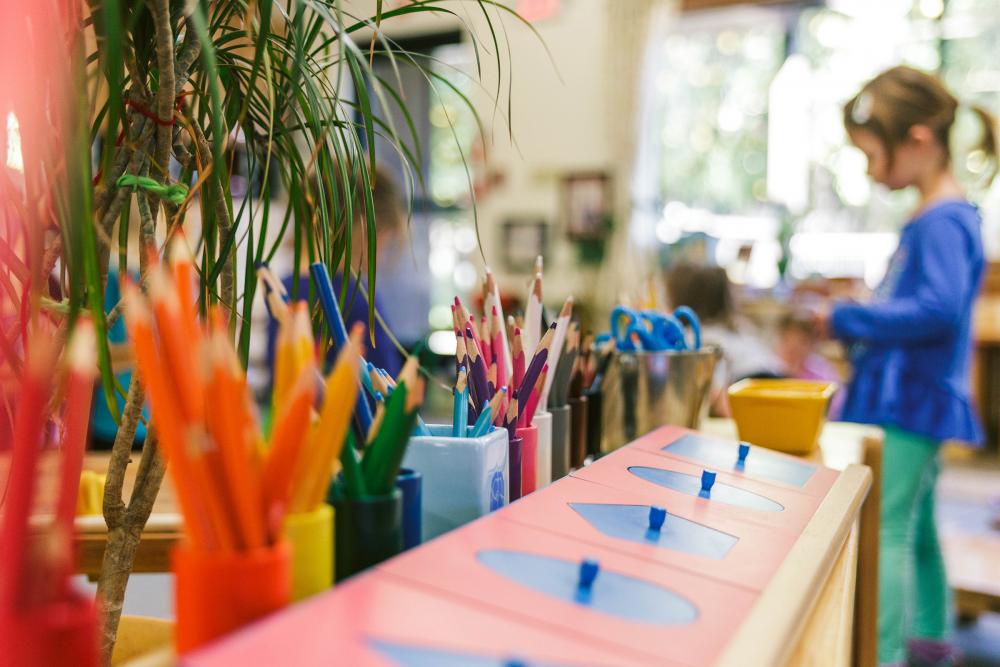
The first metal geometrical insets as well as some outlined figures are connected with writing. By running the point of a coloured pencil along the edge of the insets, the child draws their forms which he then proceeds to fill in with pencil strokes. This prepares the hand of the child to follow contours and to acquire great control in the manipulation of a writing instrument. So the ability and elasticity of the hand is ready to obey the mind by the time maturity ensues, and writing happens. But children have their own interests as well, and in this case, besides getting unknowingly the hand ready to manipulate a writing instrument they did - and they do - develop artistic combinations of shapes and colours. These exercises are so attractive to them that the children call them 'drawing'.

But let Dr. Montessori speak for herself. What follows is the text of part of a lecture:
'There is no doubt that it is pleasing to the child to fill in these designs; we did not make the child do these exercises; we saw that he had a spontaneous desire to do them. For the child's hand which is uncoordinated, and therefore incapable, a guide is necessary, and the child enjoys having a guide. He has an unconscious desire for the formation of himself and a pleasure in finding those limits within which that formation can take place. You can try for yourselves to see whether it is very difficult to get the child to do this exercise. You will find that once the child has started with it, it is very difficult to separate him from it.

Boy working with inset
Boy working with metal inset


But can the results really be called drawings or designs? Work with the metal insets does not teach the child to draw, to reproduce what he sees. They are a preparation for writing....By making these little designs and filling them in, learning to use pen or pencil is given a more pleasurable and perfect form. Since they also use coloured pencils, drawing the little lines in this form, allows the children to elaborate and to apply the appreciation of colour previously acquired during the work with the colour tablets. In this case they are able to apply this power in making harmonious combinations. But I would reiterate that I do not consider the result to be drawings, although most people continue to refer to them as such. We do not really have a satisfactory word available: We cannot refer to the efforts as writing nor as drawing. It is certainly an exercise which prepares for writing and, undoubtedly, also is an exercise which prepares for drawing. It is something that has the characteristics of both - at this juncture nothing is determined.

It is needless to repeat that all this simply serves as a basis, and that the child is free to apply his knowledge spontaneously and will pass from the use of this material to free drawing. This is the reason why we do not, in this material, give a continuous series of objects where the progression is uninterrupted, because our material simply represents what we might call "an inspiration" to stimulate the child to work spontaneously; and what material can there be to correspond to spontaneous work?

Girl working with inset
Girl working with metal inset

We give the technique and fundamental facts that are necessary, and then we allow the child to develop by himself along these lines, and await the results. When we give the child the technique of the use of the objects, and the possibility of coordinating his movements, when we have initiated him into the distinction and enjoyment of colours and have prepared his eye to recognise things clearly, then we have done all that we could do.

We wish to give (the child) the means by way of which he may express himself, and without doubt expression through drawing is one of the greatest of human manifestations. It is on the same level as the spoken word and the written word. We may say that as gesture accompanied spoken language, so drawing is the gesture which accompanies written language.

Perhaps you might ask: 'How will these children learn free drawing if they are continuously given a piece of iron to outline? How will they come to draw by themselves, and what means do you give them to enable them to do so?' This, however, is one of those things we cannot teach. But by the preparation just described, the child becomes master of his own hand and he will exercise it. We now only need to wait and see if that which should come, will come. And in general we shall find that there will be only rare cases of children who do not draw. Drawing comes spontaneously.

Together with imagination, creative force is developed by reading, by studying geography and history and by visiting museums.'

The children Dr. Montessori described had acquired the ability to draw and were free. And being free they expressed what they felt. Do children after twelve stop talking or writing? If they stop drawing, it means that they are dissatisfied with their ability to express themselves. Will this phase of the present conception of free expression last? It does not seem so.

The free spirit of man who has the physical ability to express himself will use this ability not in copying but also in free composition.

Mario M. Montessori

© AMI, 2001