C 25th International Montessori Congress
Declaration
Congress Papers
View Highlights
Photos
Feedback
Programme
Speakers


It was 30 years ago when I became deeply moved by the essence of Montessori education and I wished so hard to deliver this method to the children of Japan. That’s why I started the AMI teacher training course in Tokyo in 1975.

That time was called an age of crises of children and school and everyone involved in education was in search of a better approach to early childhood education. Then, Montessori education was highly accepted because of its focus on the individual child, logical thinking, and the belief that children’s ability to understand derives from actual hands-on experiences during childhood.

In the past, Montessori education was not well appreciated by the traditional educators in my country. Their misunderstandings were focused  on the aspects of; activities based on free choice; the meaning of concentration; the benefit of mixed age groups; and the role of teachers in the classroom; and the reason for analytical and slow movement.

Nevertheless, the fact is the revival of the Montessori movement in Japan around the 1970’s prevailed and is still going strong. In Japan, there are 1,501 AMI Montessori diploma holders and 3,604 diploma holders from four other Montessori courses run by the Japan Association of Montessori, totaling 5,105 “Montessorians” in Japan. The number of schools run by Montessori method is approximately 3,500.

 This proves to me, despite the earlier criticism, that Japan must have some kind of readiness for appreciating Montessori. I came to this realization when I was told by someone (as a criticism) that the particular movements used in Montessori resemble “the manners in tea ceremony” in Japan.

It is true when I first saw my trainer in Italy, Ms. Antonietta Paolini, presenting the silence game, I felt the strong connection to the tea ceremony. Though one is education and the other is cultural ceremony, I felt “they shared very simple yet refined movements.”

The custom of tea drinking was brought from China by Buddhist monks and Kentoshi, a group of Japanese envoys to China during the Tang dynasty in the early 9th century. It was brought to Japan because tea drinking has some beneficial effects on both physical health and mental stability.

Over a period of time, sado, the way of tea, spread from the aristocracy to the Samurai class. The art of tea drinking gave the Samurai warriors a precious moment of relaxation and peace of mind in the chaos of civil wars and it also offered them an opportunity to encounter Zen philosophy, a new insight to life for them.

Gradually, the tea drinking custom spread among the general public in Japan, helped by the custom’s free and fair spirit of treating all social classes equally. The way of tea is a way of looking into the core of one’s life. Through a series of repeated lessons, we prepare ourselves to be worthy of receiving guests.

We have a Japanese phrase derived from tea ceremony called “ichigo ichie”, which literally means “one opportunity, one encounter”. In tea ceremony, when we serve a bowl of green tea to a guest, we consider this encounter as if it were a singular, new moment that will never recur in one’s lifetime, so we treat the guest with the utmost sincerity when we prepare a bowl of tea.

Being a tea ceremony practitioner myself, I feel the same love and reverence to a guest in the teahouse and to the children in the Montessori environment.

The following photographs are to give you some ideas on how Japanese Shogun, the samurai generals of the past, took so much care and pride in selecting each element in preparing the environment just to offer a bowl of green tea.

First of all, the landscape of the garden around the teahouse (Photo 2),
the design of the teahouse (Photo 3),
the choice of the bowl (Photo 4),
the flowers used on that day (Photo 5),
the calligraphy on the wall (Photo 6),
the scroll painting (Photo 7),
the food for the occasion (Photo 8).

The integration of these different kinds of selected elements produced the rich culture of tea ceremony.

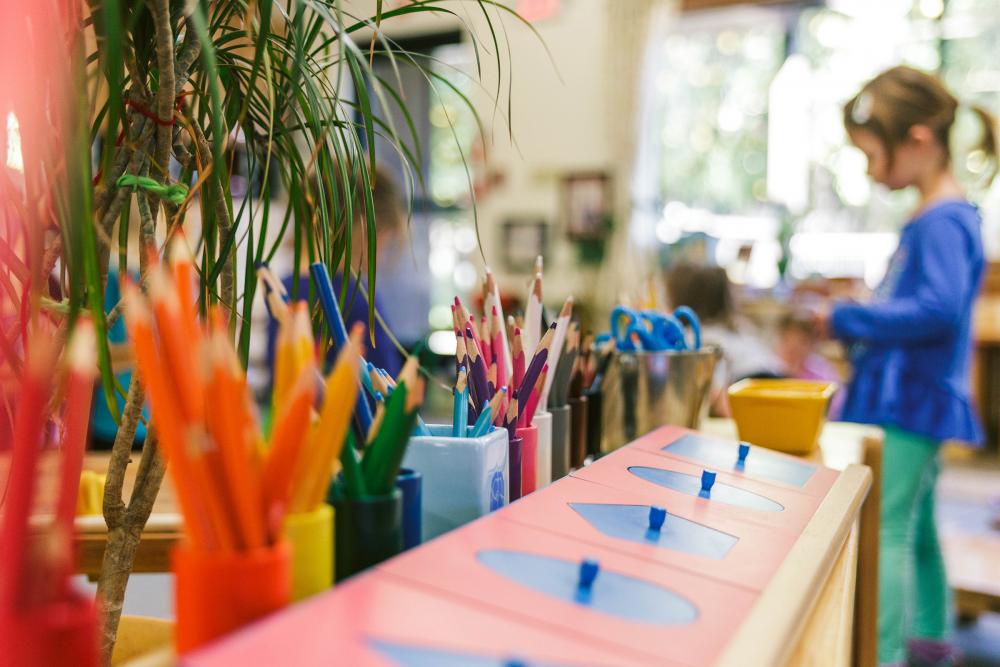
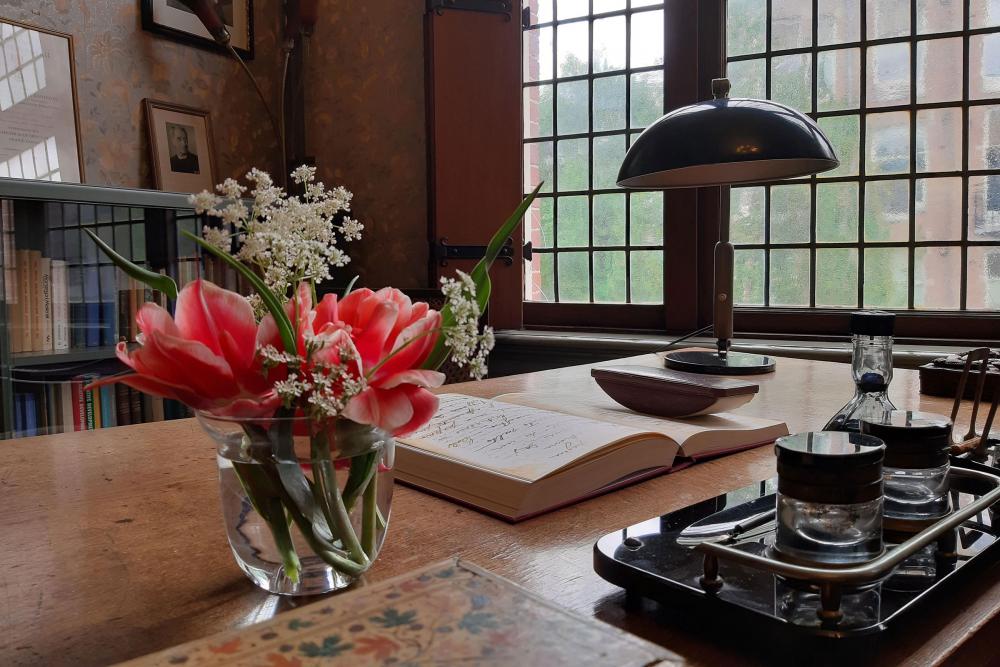
In order to value the moment and to enjoy the time with the guests, the host prepares the environment whole-heartedly, before the guest comes, by tending the garden, preserving the serenity in the teahouse by cleaning it carefully, hanging a scroll painting in the alcove, and arranging one seasonal flower to welcome the guest. I find a similar practice when Montessori teachers prepare the environment so attentively and carefully before the children come into the classroom.

To me, this philosophy of “ichigo ichie” is practiced and represented not only in the teahouse but also in the Montessori environment when we greet each child as if he or she is a new child everyday and enjoy the moment with the children by being “here and now”.

Children are living “now”, not in the past, nor in the future. The life force within the child may be seeking for help that needs to be satisfied today and not tomorrow. The teacher may never have another chance to help the child but today. A presentation may need to be done now at this moment and the real encounter between the child and learning may never take place if it were presented later or tomorrow. The growth of a child is a reflection of the inner life force and this is the power within the child that keeps beaming in defiance of any difficulties.

Now, let’s get back to the ritual of the tea ceremony. The ceremony starts with the offering of sweets to the guest, then carrying the necessary tools for tea ceremony and purifying the tools before use. These are simple steps with comprehensive movements and they are performed in sequence. Observing these steps makes one feel relaxed and brings a sense of serenity.

 Here, I would like to show you some images of steps that resemble the presentation in a Montessori classroom. The tea ceremony consists of 5 steps:

1) Setting up; 2) Purifying the tools and the mind of the host; 3) Making tea; 4) Cleaning and checking the tools for the next use; and 5) Putting them away.  

1) Setting up the materials: Laying out the materials. 

  • Greet the guests after placing the water-container at the host’s entrance.
  • Carry the water-container, bowl and tea powder canister, and waste water receptacle into the corner.
  • Hold a ladle and rest it on the lid and bow to the guest.
  • Push forward the waste water container and check one’s posture for the ceremony.

2) Purifying the materials: Checking, confirming.

  • Place the tea bowl and the tea canister in front.
  • Fold the silk cloth and wipe the tea canister and ladle 3 times and take out the whisk.
  • Bring the tea bowl to oneself and hold the ladle. 
  • Lift the lid off the kettle and place the linen cloth over it.
  • Pour hot water into the tea bowl and warm the tea whisk. (Check the whisk 3 times.)
  • Warm the tea bowl and wipe with the cloth.

3) Making tea ; actual serving of tea.

  • Take the tea canister and scoop powdered tea into the bowl.(2 scoops.)
  • Take the lid off the water container and pour 1 ladle of water into the kettle.
  • Pour hot water into the tea bowl and make tea.
  • Wait for the bow from the guest and pour 1 more ladle of water into the kettle.

4) Cleaning: Washing the tools and checking the tools for the next use.

  • Rinse the tea bowl with hot water.
  • Bow to each other as the sign of closure.
  • Rinse the tea whisk with water twice.
  • Put the linen cloth and whisk in the bowl.  
  • Take the tea scoop and bring waste water receptacle toward oneself.
  • Wipe the tea scoop with a linen cloth and rest it on the bowl.
  • Return the tea canister and bowl back to their original places.
  • Pour water into the kettle, hold the ladle, and replace the lid of the kettle.
  • Hold the ladle and close the lid of the fresh-water container.

5) Putting away the tools: Returning the materials back to their original place.    

  • Holding both the ladle and the lid rest, carry back the waste water receptacle.
  • Put away the bowl and tea canister.
  • Place the water container at the entrance and exchange final bows to each other.

Every tool we use in tea ceremony is hand-made by the artisans who can transform their mind into a concrete form that is very simple and earthy.

Tea bowls are either made of porcelain or earthenware depending on the season.

The tea canister is made of lacquered wood.

The tea scoops, whisks, and ladles are made of bamboo.

Water is boiled in an iron kettle over a charcoal fire.

From these materials, you can tell how much the four seasons are respected as well as how life in Japan is intertwined with nature natural materials.

While the host prepares all these materials to express respect for the guest, the guest also feels the heart of the host by sight, by smell, by touch, by all the senses. I feel this mutual exchange of reverence between the host and the guest also takes place in the Montessori school. The teacher prepares the environment to aid the utmost development of the children and every single child is treated with care as our special “guest”.

I would like to conclude my speech with a quotation from Maria Montessori on love and reverence for children from the last chapter in “The Absorbent Mind”.

“No one can describe or evaluate the immense consequences which flow from  love, or gather up its potency for union between men. Despite our differences of race, of religion, and of social position, we have felt, during our discussion of the child, a fraternal union growing up between us.”

“If in all its aspects this energy of love is conceded to man as a gift to salvation,…..it must be treasured, developed and enlarged to the fullest possible extent. Man, alone among living creatures, can sublimate this force which he has received and can develop it more and more. To treasure it is his duty. It holds the universe together because it is a real force, and not just an idea.”

© Maria, S. Matsumoto, 2005