Highlights from 'Communications 2003/4'
The Universality of Montessoris Discoveries
The Second in a Series on Montessori Endeavours Worldwide
This issue of Communications presents accounts of some Montessori work undertaken with families and communities in Asia, Australia and Europe. We hope that these stories will encourage others to share their own experiences in future issues.
The examples from three continents show that the Montessori approach fits well within diverse cultures, also with refugee children, street-children, and those in vulnerable environments. We thank Victoria Barres for initiating the series and for keeping the idea alive. Our thanks also go to Zarin Malva, Dinny Rebild, and Takako Fukutsu for their contributions.
To give you an idea of the projects reported on:
Montessori ProjectsAustralia
At the recent Montessori Conference in Sydney, Australia it was heartening to learn that the indigenous communities especially appreciate the fact that within Montessori their own culture is respected, the children can progress at their own speed and there is no emphasis on competition. Australia is fortunate to have two Montessori projects with indigenous communities.
AseemaIndia
Aseema, a non-governmental organisation established in 1995, promotes and protects the human rights of under-privileged children and women. It draws inspiration from the United Nations Convention on the Rights of the Child.
There has been a growing concern in India about the shortfalls in implementing the educational programmes, especially in the area of primary education. Aseema has dedicated the first phase of its programme to address exactly this issue and established the centre for street children in Mumbai on 15th December 1997. The uniqueness of this centre lies in its Montessori philosophy and teaching approach.
A Montessori centre has been established for children aged two-and-a-half to seven years. It is the first of its kind for the children living on the streets of Mumbai. Fully equipped with Montessori apparatus and run by two trained teachers, the children thrive under the nourishing love and learning they receive at the centre.
J.s StoryDenmark
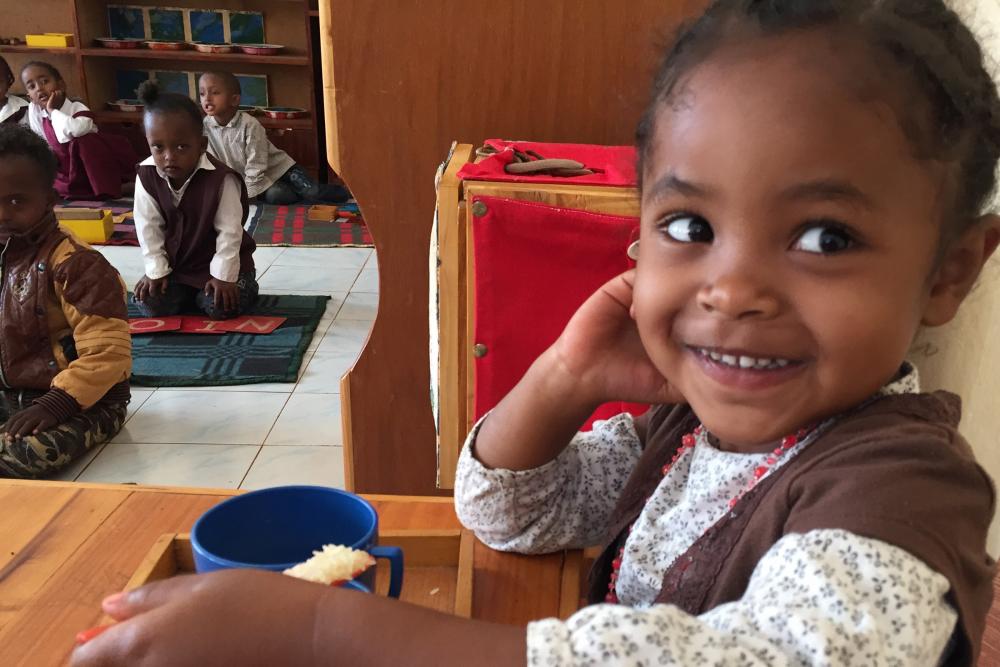
This is the story of a two-year-old child who has lived in a refugee centre her whole life. Her parents fled from one of the many wars the world is witness to in these years, together with two other children of then eight and ten years. Both parents were traumatised and more and more J. was looked after by other residents at the centre and by her siblings. To compensate for love that could not be given, J. was fed enormous amounts of food, so by the time she began in Project Small Children she was very obese.
Commitment to a Wider Community: The Global Child An Example from Southeast Asia
This was the title of a lecture presented by Takako Fukatsu at the Montessori Conference in Sydney, Australia: Sept. 26 to 28, 2003.She describes some of the work she did in a refugee camp and how she was haunted by the pressing question of how peace can be achieved. Her experiences eventually brought her to Montessori, and later to the Educateurs sans Frontières. Together with Victoria Barres she explained how the idea of Educateurs sans Frontières can propagate and spread Education as an Aid to Life which is how Maria Montessori herself described the pedagogy she created.
Contents
We continue our feature of Maria Montessoris lectures delivered at the 8th International Montessori Congress, on 22-29 August, 1949, whose title was La Formazione dellUomo nella Ricostruzione Mondiale (Mans Formation in World Reconstruction). This instalment is the lecture 'Human Solidarity in Time and Space'
(
) I remember reading in an Indian book a story that made a deep impression on me. It told the tale of a little shepherdess who had decided to make her environment more beautiful by planting two plants. One was for her own pleasure, the other she dedicated to God. Upon the latter she lavished special care, watering it diligently, protecting it from the sun and keeping it free of insects. The first she neglected, leaving it to the care of others. Contrary to every expectation, the plant dedicated to God died, while the other flourished. In despair, the little shepherdess wondered why her ministrations had had such disastrous results. The reply was: You gave this plant too much water, you protected it from sun and insects while the plant needed chlorophyll from the sun, and insects for its growth and reproduction. You, yourself, destroyed it with your care.
The same phenomenon occurs in the field of education. Often, the interference of family and educators, even if inspired by the best intentions, becomes an obstacle to the free development of the creative forces within the child, oppressing and suffocating his inner energies, obstructing the natural forces necessary for life.
Contents
The Formation of Mind
Language, Learning and Logic in Early Childhood
Dr Annette Haines is an AMI Director of Training, holdings both AMI Primary and Elementary diplomas. In this lecture she talks about how language is present in a human being's life from day one. She addresses physical, biological, and psychological aspects and also touches upon the difference in language acquisition in the early years between boys and girls.
"Human beings are not born with language. Little mammals, babies are born with just those instincts necessary for life. Yet, beneath this apparent helplessness (and Montessori was struck with this fact) babies can do amazing things. Newborn infants can do something we cannot: they can suck and swallow without stopping for a breath. As Dr. Montessori understood (being a physician), the necessary muscular coordinations are not yet in place which are needed for speechcoordinations which allow an extended stream of air to pass over the larynx. The baby can only breathe, cry and suck (and a few other things). But, as Montessori said the child possesses a psychic life antecedent to its life of motion. (1936/1983, p. 34) The baby can look and listen.
(
) Language learning starts as motor movement and remains motor movement stimulated by auditory signals of the mother. The mother does not teach her baby to talk, nor does the baby teach himself. Both are doing this work together, equally drawing on what Howard Gardner calls a universal intelligence of language which is over and above both of them. The infants body moves in a precise shared rhythm with the organisation of the speech patterns of the culture.
Dr Haines concludes " Language is made up of words, and words in language make certain patterns and take on a certain structure which give them their meaning. These patterns adapt to a certain order and, for the most part, maintain that order. The child, with each new generation, absorbs and maintains the patterns, the structure and the order of language. In completing this task, order is created in the childs inner world; order is given to that internal universe, and to all the matter and energy of that universe which is the mind."
Contents
"The Child as Builder of Humanity
Patricia Wallner wrote a glowing report on the Lead-in Conference The Child as Builder of Humanity that was held in Sydney, AustraliaSeptember 2003. Share some of her remarks here and start getting reading for the big event in 2005: the 25th International Montessori Congresss, also to take place in Sydney.
"Imagine a beautiful city, a Darling Harbour city, fingers of land interlaced with water sparkling in the sun and one of the most famous buildings in the world arching whitely into the blue sky. (
) Picture a convention centre with walls of glass, its main hall lined with displays of books, art supplies, and Montessori materials presented by old friends like Nienhuis and Gonzagarredi."
Imagine arriving at this centre and being met in the parking lot by a smiling hospitality volunteer sporting a bright pink scarf who escorted us into the elevator and rode up with us to be sure we had no problems finding the registration table and our personalised satchels containing the conference information.
(
) Meanwhile, the 2005 International Montessori Congress in Sydney is now being planned and prepared for with enthusiasm (
) The women and men who planned this forerunner to the Congress did a superb job. Thank you to the Australian AMI Alumni Association and the Montessori Association of New Zealand Inc.
I urge you all, save either your dollars, euros, yen, pesos or all of these currencies and start planning for July 2005. If the conference this past September is any indication, the 25th International Montessori Congress will be an experience none of us should miss! Go to: http://aaaa.net.au or email montessoricongress@bigpond.com
The special congress website will be up and running shortly. The address is http://ami.edu/congress.
Contents
Question and Answer
This issue's "Question and Answer' feature focuses on 'Writing and Left-handedness' and briefly outlines Montessori's ideas on the indirect and direct preparations for writing, and how she connects motor and intellectual activity.
Contents
|