'Communications - 2002/2-3'

'Communications' is the journal of the Association Montessori Internationale. This publication includes articles by Dr Montessori as well as scholarly papers on Montessori and related topics. Currently, two issues are published each year. AMI also produces a newsletter 'The AMI Bulletin' which is published three times a year and features Montessori news and articles from around the world. 'Communications' and the 'Bulletin' are sent to all members of AMI. Click here to become a member of AMI. Please note: AMI membership is open to individuals only.

 Listing of AMI 'Communications' 

Contents

Second Assembly of the Educateurs sans Frontières

Language and Thought
Ann Dunne

Obituaries: Gianna Gobbi, Gool Minwalla and Kira Banasinska

Report of the Annual General Meeting

Spotlight on the Objectives of AMI’s Articles of Association
An Address by Renilde Montessori

Financial Report - 2001

AMI/USA Report

Report on the Activities of the MM 75 Fund in 2001

April in Amsterdam photographs

General Report on AMI Training Centres in 2001

Other Reports

Glossary of Montessori Terms
Annette Haines

Training of Trainers Programme - A Second Option Open to Prospective Trainees

Montessori in the New Century
Elisabeth Houweling

Question and Answer
Multilingualism

Life Membership

Announcements

 Listing of AMI 'Communications' 

Highlights from 'Communications 2002/2-3'


Language and Thought - Ann Dunne

Ann Dunne wrote an interesting article on ‘Language and Thought’ in which she discusses ‘the function of language, its job in our daily lives, and why Montessori places so much emphasis on the natural development of language in children.’

Firstly she outlines the Montessori theory and practice with regard to language development; she goes on to compare and contrast these with contemporary views; she concludes that ‘language is a, if not the, most important skill for human learning and communication.’

She refers to studies which show ‘that with vocabulary growth comes increased opportunities for using words in the development of thinking, which in turn prompts further linguistic development. If children can use language to express and communicate their feelings, their emotional growth will also be greatly enhanced.

…It can certainly be argued that the Montessori language programmes at both levels allow children to acquire the means to interpret, explore, make logical judgements, clarify the language they already have, express their needs, emotions, ideas and unique individuality in a concrete way whilst developing the mechanical skills and acquiring the knowledge and culture appropriate to their society and nation, and in so doing help them to reach clarity of thought and independence of intellect.’

 Contents 


Spotlight on the Objectives of AMI’s Articles of Association
An Address by Renilde Montessori

In her closing address at the Annual General Meeting of April 6, 2002, Mrs. Montessori referred to the objectives of the Association Montessori Internationale, as formulated in the Articles of Association and drew attention to the fact that not all articles are being actively and/or fully pursued. To illustrate this statement, she quoted from the Articles as follows:

Article 3: The objectives of the association are to maintain, propagate and further the ideas and principles of Dr. Maria Montessori for the full development of the human being.

She stressed the need to study this article carefully. AMI’s work is not just to follow Dr. Montessori, but should encompass the full development of the human being, a wider perspective to be kept in mind at all times. She remarked on a lack of respect for children as human beings from the time they come into the world, and posed the challenging question: ‘How are we going to respect these children? How are we going to help them to fulfil their potential?’

Mrs. Montessori reminded the meeting that the answers are to be found in Article 4, which reads The association aims to accomplish the objectives referred to in article 3 by all lawful means and in particular by

4a. Furthering the Study, Application and Propagation of the Montessori Ideas and Principles for Education and Human Development.

‘How many of those gathered here today continue to study the writings of Maria Montessori?’ she asked, mentioning Dr. H. Ludwig’s commitment to bring out academic editions in Germany with the aim of helping people study her work in the German language. Dr. Montessori herself was first and foremost a scientist. She was a pedagogue as a result of a combination of sciences; she became a pedagogue because she - as a doctor, as an anthropologist - discovered the characteristics of the development of the human being. She discovered something very simple, something many people throughout time had instinctively been heeding, namely the natural tendencies of the human child when it comes into the world.

But the study of the child is something without end. Maria Montessori continued to study the child throughout her life, maintaining that ‘it is our mandate to become scientists of the child’. Thus our teachers must continue studying the child, and Dr. Montessori gives guidelines for this study. All of us who have studied Dr. Montessori’s books in the past and pick them up once in a while, will always find something new because of her very profound scientific background. We shall, without fail, gain new insights.

Someone who obtains the AMI diploma and consequently applies all the tricks in the classroom, is not a scientist of the child. Applying and propagating the principles of Dr. Montessori require study, and there is no doubt about that.

4b. The propagation of knowledge and understanding of the conditions necessary for the full development of the human being from conception to maturity both at home and in society.

This is a powerful mandate. To propagate the knowledge means that we already have the knowledge. This is also recognised by others, such as the UNICEF representative at the 2001 Congress in Paris who said: ‘You Montessorians have an extraordinarily specialised knowledge and methods to deal with children, a vision of education that is very much in demand and necessary in the world of today. Do something about it. You have something to give, give it’. Likewise, school administrators should not only administer, but also propagate the knowledge, by applying the principles and opening up the schools to the public around them, the parents and the community. That way, ripple by ripple, the knowledge of how to observe children, how to respond to the children's developmental phenomena will become part of our human condition.

4c. accrediting centres where people may be trained according to the principles and practices of education as envisaged by Dr. Maria Montessori.

Mrs. Montessori stated that the objective laid down in this article is currently being realised. She thanked the Committees, the Directors of Training and everyone working in this area and concluded that this aspect of the Association is firmly in place.

4d. helping to create a climate of opinion and opportunities for the full development of the potential of all young people so that humanity may work in harmony for a higher and more peaceful civilisation.

The creation of a climate of opinion comes with the propagation of knowledge. These powerful words require reflection. For instance, at the beginning of an AMI course, students often start preaching Montessori to their partners, neighbours, etc., but that usually has the opposite effect. Therefore we must be more subtle, subversive at times, like going as neutrinos through the tissue of society. We must bring what is important in a quiet way, without criticism, by small measures such as helping people to look at children. Especially young adolescents can be made aware of the texture of this climate, can learn what a child is all about, as they have something in common, namely the urge to become independent. Give young adolescents the opportunity to be with small children. By doing so, a climate of benevolence towards the new human being is created. And when this is built into their being, it will be there when they grow to be adults and parents themselves.

4e. promoting general recognition of the child's fundamental rights as envisaged by Dr. Maria Montessori irrespective of racial, religious, political or social environment.

This objective is easy to understand for most Montessorians. The fundamental rights of men, and of the child, have been discussed in many places and times. How to recognise these rights is another matter. The aspect irrespective of racial, religious, political or social environment is something the whole world is becoming increasingly aware of.

4f. co-operating with other bodies and organisations which promote the development of education, human rights and peace.

AMI is not the only organisation in the world promoting the development of education, human rights and peace. Although it has its own individual approach, there is a lot of common ground with other organisations; and if all were to unite their efforts, a tremendous strength would result. This was very noticeable at the Congress in Paris. It is important to know of these organisations, and to see where aims coincide. By uniting with others, AMI’s own aims can be strengthened.

 Contents 


Glossary of Montessori Terms compiled by Annette Haines

Any science has it own vocabulary and terminology and the Montessori Method is no exception. Montessorians share a very specific set of references, references which of themselves are brief and succinct yet each one evokes the world of the child as described by Maria Montessori. Montessori language acts as a password, enabling the sender and the receiver to immediately decode the message being transmitted.

This glossary was prepared by Annette Haines at the request of Molly O’Shaughnessy to accompany her lecture at the Joint Annual Refresher Course, held in Tampa, Florida in February 2001.

As an appetizer to the full glossary, here are just a few:

Control of Error: A way of providing instant feedback. Every Montessori activity provides the child with some way of assessing his own progress. This puts the control in the hands of the learner and protects the young child's self-esteem and self-motivation. Control of error is an essential aspect of auto-education.

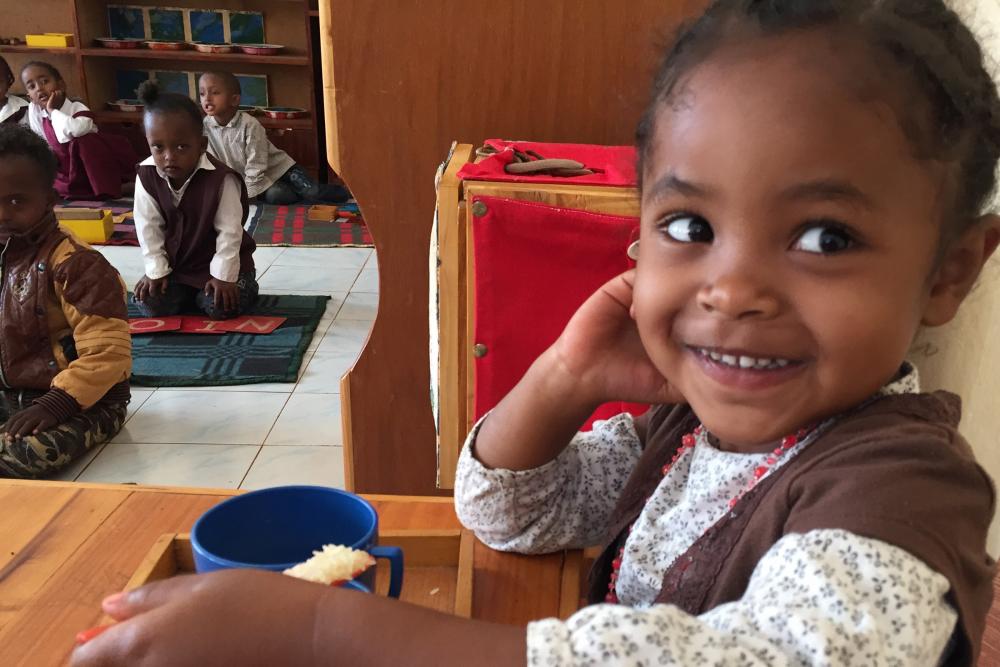
Exercises of Practical Life: One of the four areas of activities of the Montessori prepared environment. The exercises of Practical Life resemble the simple work of life in the home: sweeping, dusting, washing dishes, etc. These purposeful activities help the child adapt to his new community, learn self-control and begin to see himself as a contributing party of the social unit. His intellect grows as he works with his hands; his personality becomes integrated as body and mind function as a unit.

Mixed Ages: One of the hallmarks of the Montessori method is that children of mixed ages work together in the same class. Age-groupings are based on developmental planes. Children from 3-6 years of age are together in the Children's House; 6-9 year-olds share the lower elementary and the upper elementary is made up of 9-12 year-olds. Because the work is individual, children progress at their own pace; there is cooperation rather than competition between the ages.

 Contents