Communication 2000/2-3

'Communications' is the journal of the Association Montessori Internationale. This publication includes articles by Dr Montessori as well as scholarly papers on Montessori and related topics. Currently, two issues are published each year. AMI also produces a newsletter 'The AMI Bulletin' which is published three times a year and features Montessori news and articles from around the world. 'Communications' and the 'Bulletin' are sent to all members of AMI. Click here to become a member of AMI. Please note: AMI membership is open to individuals only.

 Listing of AMI 'Communications' 

Contents

Farewell to Bob Portielje

Science and the Montessori Casa dei Bambini
Annette M.Haines

Report on Annual General Meeting

Financial Report - 1999

A Pictorial Impression of the April Meetings

AMI/USA Report

Report on the Activities of the MM 75 Fund in 1999

General Report on AMI Training Centres

Other Reports

Centro Internazionale Maria Montessori, Perugia, Italy Celebrates Its 50th Anniversary
Sara Concas Spoleti

Question and Answer
Is the Montessori Method not Outdated?

Announcements


 Listing of AMI 'Communications' 

Highlights from 'Communications 2000/2-3'


Farewell to Bob Portielje

Some of the words spoken by Bob Portielje on retiring from the 'job' as AMI's President

"...I am grateful for the opportunity to say 'off the record' a few words to everybody from the AMI community, who allowed me, an outsider in the field of education, to hold this prestigious post. It goes without saying that this gratitude is matched by my indebtedness to Djoeke, without whose help I couldn't have done the job. But I would particularly like to thank all of you (...) for your understanding and, above all, your loyal and warm friendship.

May AMI flourish under the more than capable new president, Renilde, the general secretary, Mary and chair of the Executive Committee, Hilla: they will continue to guarantee the high standards for which the Association stands.

....Thank you, AMI. I fell in love with this 'job' and wouldn't have missed one minute of it."

Upon being made an honorary member of the association Bob Portielje said "I am more than grateful for the honour conferred on me by the AMI Board".


Some of the words of appreciation spoken on that occasion:

We celebrate almost a 'life-time' of Montessori: Bob's commitment and interest in Montessori as a parent led to over forty years of active Montessori involvement.

Thank you for your continued and unflinching support throughout all the years.

Bob, you were a binding factor, the cement which helped build and consolidate today's structure of AMI.

We are fortunate to have Bob always available for consultation, sensible advice and his friendship.

It's not goodbye...it's au-revoir.


 Contents 


From Science and the Montessori Casa dei Bambini, an article by Annette M. Haines Director of Training at the Montessori Training Center of St. Louis, Missouri.

This article was first delivered as a lecture to the North American AMI Trainers' Council held in Tempe, Arizona in November, 1999.

The article's introduction by Renilde Montessori also serves to spark off discussion of the subject.

(From the introduction)

...Neither shall we know whether children in Montessori schools will be more or less scientifically inclined if in the Casa dei Bambini they are presented with science exercises or not. To have, or not to have science in the three-to-six classroom is a quietly enduring tug o' war between two factions in our very own AMI pedagogical community. We do not bandy neither do we hurl. We are civilised, we endeavour to uphold the principles of grace and courtesy which presumably are second nature to us, yet we tenaciously clamp our jaw around our well-founded convictions on the subject, sinking a powerful fang into a rationale made from solid bone.

Annette Haines offers a superbly lucid, well-illustrated exposé of pedagogical reasons for not having science exercises in the Children's House. We would like to invite defenders of the other faith to come forward with an equally eloquent avowal of their conviction that simple science experiments have a place in a prepared environment for children from three to six years of age.

(From Annette Haines' article)

In order to talk about science in the environment we prepare for the 3&endash;6 year-old, we must first ask, "What is science?" Science is a method of inquiry, a mode of investigation which makes a systematic attempt at creating knowledge.

(...) Scientific progress can be seen as the exploration of error. Most scientific hypotheses or theories are wrong: the scientific community sees that wrong ones don't get published. Right ones are made with "the tears and sweat (at any rate, with a good deal of bad language) by people who are constantly getting the wrong answer" (1978, p.111).

Science is done by the scientific method. You probably remember learning about the scientific method in school: formulate a hypothesis; construct a straw man (a null hypothesis); and design an experiment to see if the empirical evidence is enough to reject the null hypothesis with a certain level of probability that your results are not the result of chance variation. It is a powerful tool, but it cannot prove anything; it can only disprove. Science thus requires a certain attitude of scepticism (Shaughnessy & Zechmeister,1990, p. 21). No truth is so sacred that it cannot be tested.

(...) Scientific experiments are usually done in a laboratory where the variables can be controlled. The researcher lets the one variable he wishes to examine be a free or independent variable. Maria Montessori described her method as "scientific pedagogy". In the laboratory of the prepared environment, all the variables are controlled except one: the child. The child is the independent variable. Behaviour is recorded through narrative records and checklists documenting the frequency of specific behaviours, the duration of the behaviour, and so forth. It is essential to give the children freedom because only when the children are free, can we clearly see their individual differences.


 Contents 


Centro Internazionale Maria Montessori - Perugia, Italy Celebrates Its 50th Anniversary

In July, 2000 The Centro Internazionale, Perugia celebrated its 50th anniversary - fifty years of intense work begun by Maria Montessori and continued by Maria Antonietta Paolini for many years. Since 1950, thirty-four international courses have been held with the participation of foreign students from five continents as well as Italian students; eleven national Children's House and Elementary School courses for Italian teachers and advanced courses for teachers trained by Mario Montessori in 1956 and 1958 and by Maria Antonietta Paolini in 1960. In all, the Centro has prepared a total of 3,676 teachers.

Numerous seminars have been held at the Centro dealing with various topics related to children's psychosomatic development. Some of the many congresses and gatherings held are:

1970 - the Congress on the Centenary of Maria Montessori's Birth

1985 - the Conference on 'Teaching History' [L'insegnamento della storia nella scuola dell'obbligo]

1992 - the Conference on 'Education for Work in the Consumer Society: Thoughts on the Pedagogical Imperatives'

1998 - the Conference entitled 'The Pursuit of Science...to Construct the Science of Peace', commemorating the centenary of Mario Montessori's birth

CONGRATULATIONS !!


 Contents 


From the Question and Answer Section

Is the Montessori Method not Outdated?

Questions fall like seeds upon the mind. Some blow away, some enrich the soil of thought, a rare few germinate and grow, invigorating the spirit and the intellect.

Question: After sifting through the many questions posed at parents' evenings, one remains: Is the Montessori method not outdated?

Answer: The Montessori method is undated. It is not subject to any one time, to any one space.

Life as a phenomenon is being intensely investigated on all levels of science. Many of the orthodox disciplines have evolved to become "life sciences"; biochemistry, bio-physics, biology as an intrinsic part of psychology, etc. Maria Montessori was a pioneer of the "bio" sciences. Today she would no doubt be known as a bio-pedagogue. She herself called her method "an aid to life".

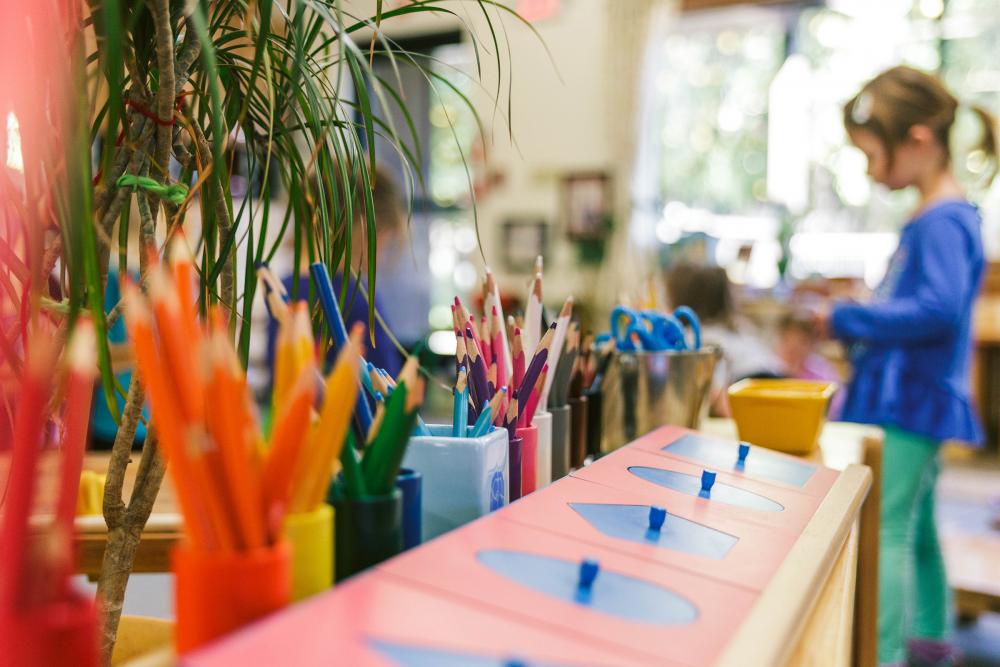
(...)Another aspect of the Montessori method, the aspect that is best known and in many cases the only one that is known, is the vast range of autodidactic materials Maria Montessori developed. Those for the very young child were created mostly in the first half of this century; it is not surprising that people wonder whether they are perhaps outdated, particularly since great quantities of excellent teaching aids have been designed in recent decades.

But there is a difference between these materials, and the names chosen to denote them express this difference admirably: "teaching aids" vs. "autodidactic materials". Teaching aids help teachers convey to the children what adults or a group of adults feel should be conveyed to them. Autodidactic materials are tools that help the young child teach himself the arts required to become a member of his group, following the dictates of inner laws.


If you want to submit questions for the Q and A section which relate to the pedagogy, please email them to AMI at questions@montessori-ami.org We look forward to hearing from you.